What Matters Most in Hydrogen Peroxide Disinfection? New Perspectives in AJIC
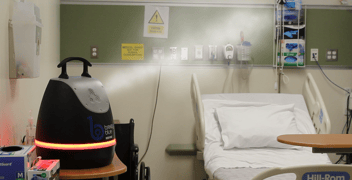
Hydrogen peroxide-based technologies are increasingly being evaluated as an approach to supplement environmental cleaning and disinfection in healthcare. But what determines whether a hydrogen peroxide system can effectively disinfect an entire room?
A new Letter to the Editor published in the American Journal of Infection Control (AJIC) explores that question and highlights an important consideration: effective whole-room disinfection depends not only on the chemistry, but also on how the disinfectant is delivered throughout the environment.
Looking Beyond Hydrogen Peroxide Chemistry
The letter, “Advancing the Science of Hydrogen Peroxide Disinfection,” responds to research by Choi and colleagues comparing automated and manual plasma-treated hydrogen peroxide mist systems in hospital environments. That study found substantial reductions in microbial contamination across inpatient, outpatient, and emergency care settings, with no significant difference between automated and manual delivery methods.
The authors of the letter build on those findings by examining the role of plasma activation. Plasma treatment can generate highly reactive oxygen species that enhance oxidation near the point of generation. However, these reactive species are short-lived and generally do not travel far from their source.
This raises a broader question for whole-room disinfection: Is the activation method the most important factor, or is effective delivery of hydrogen peroxide throughout the room equally—or potentially more—important?
Aerosol Delivery Matters
The letter highlights several factors that can influence whole-room hydrogen peroxide disinfection:
-
Aerosol distribution throughout the room
-
Concentration and dosage delivered
-
Micron-scale droplet size
-
Airflow that supports uniform dispersion
-
Access to difficult-to-reach and complex surfaces
Together, these factors help determine whether an aerosolized disinfectant reaches surfaces throughout a healthcare environment at an effective dose.
This distinction is particularly relevant when evaluating different hydrogen peroxide technologies. Rather than focusing solely on how hydrogen peroxide is activated or generated, healthcare teams may also want to consider how consistently the system delivers an effective dose across the entire treatment area.
Extending the Research to Hospital Privacy Curtains
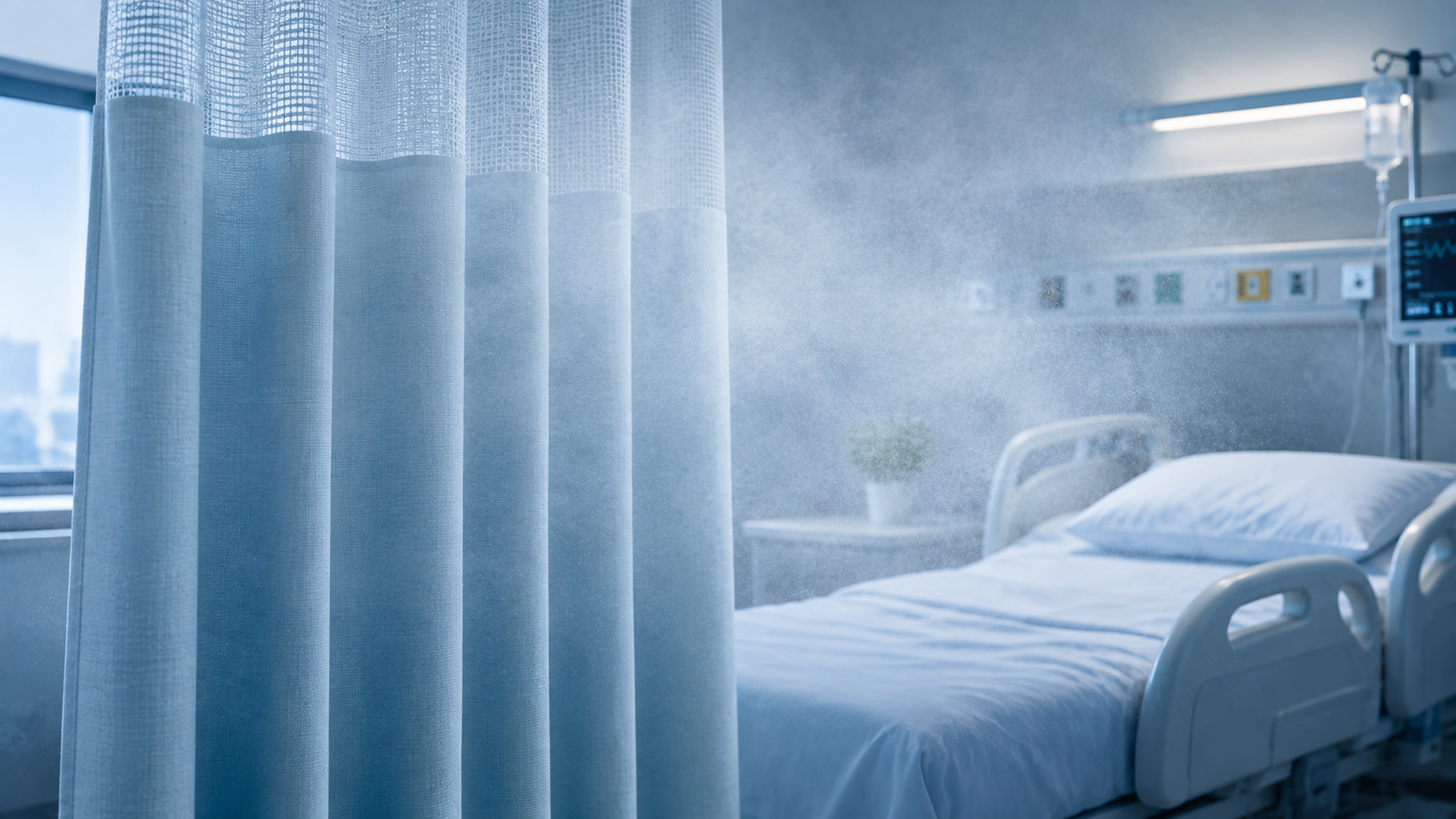
The letter also discusses recent research evaluating a nonplasma aerosolized hydrogen peroxide dry-fogging system on hospital privacy curtains—an often-overlooked soft surface in the patient environment.
Researchers evaluated a 5% hydrogen peroxide formulation with 0.01% silver ions using Bacillus atrophaeus biological indicators placed at multiple locations on privacy curtains, including front and back surfaces at varying distances from the aerosol source.
Following a 1-minute fogging cycle and 10-minute contact/aeration period, all biological indicators demonstrated complete inactivation after seven-day incubation, corresponding to ≥4-log₁₀ spore reduction.
The results provide another example of why aerosol distribution and surface accessibility can be important considerations when evaluating whole-room disinfection technologies.
Advancing the Evidence
The authors conclude that successful hydrogen peroxide disinfection may depend on a combination of peroxide chemistry, aerosol delivery, dosage, and surface accessibility. They also call for additional standardized research comparing plasma-enhanced and nonplasma aerosolized hydrogen peroxide technologies to better understand whether plasma activation provides additional clinical benefit beyond optimized aerosol delivery.
Continued comparative research can help infection prevention and environmental services teams better understand the factors that contribute to effective, practical whole-room disinfection.
Supporting the Next Generation of Infection Prevention Research
The letter was led by Cristofer Navas, BS, a Breezy Med intern, working alongside Barbara Hawkins, RN, BSN; Erik Kulstad, MD, MS; and Kathy Warye, BS.
We are pleased to see Cris contribute to the growing scientific discussion around hydrogen peroxide disinfection and to work with experienced clinical and infection prevention professionals to help advance the evidence supporting automated environmental disinfection.
Read the full Letter to the Editor in the American Journal of Infection Control: