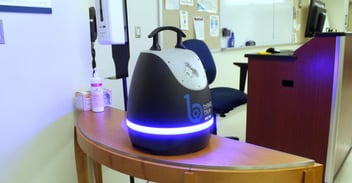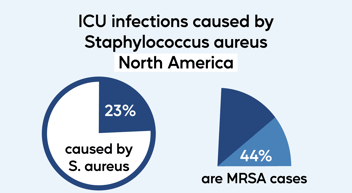
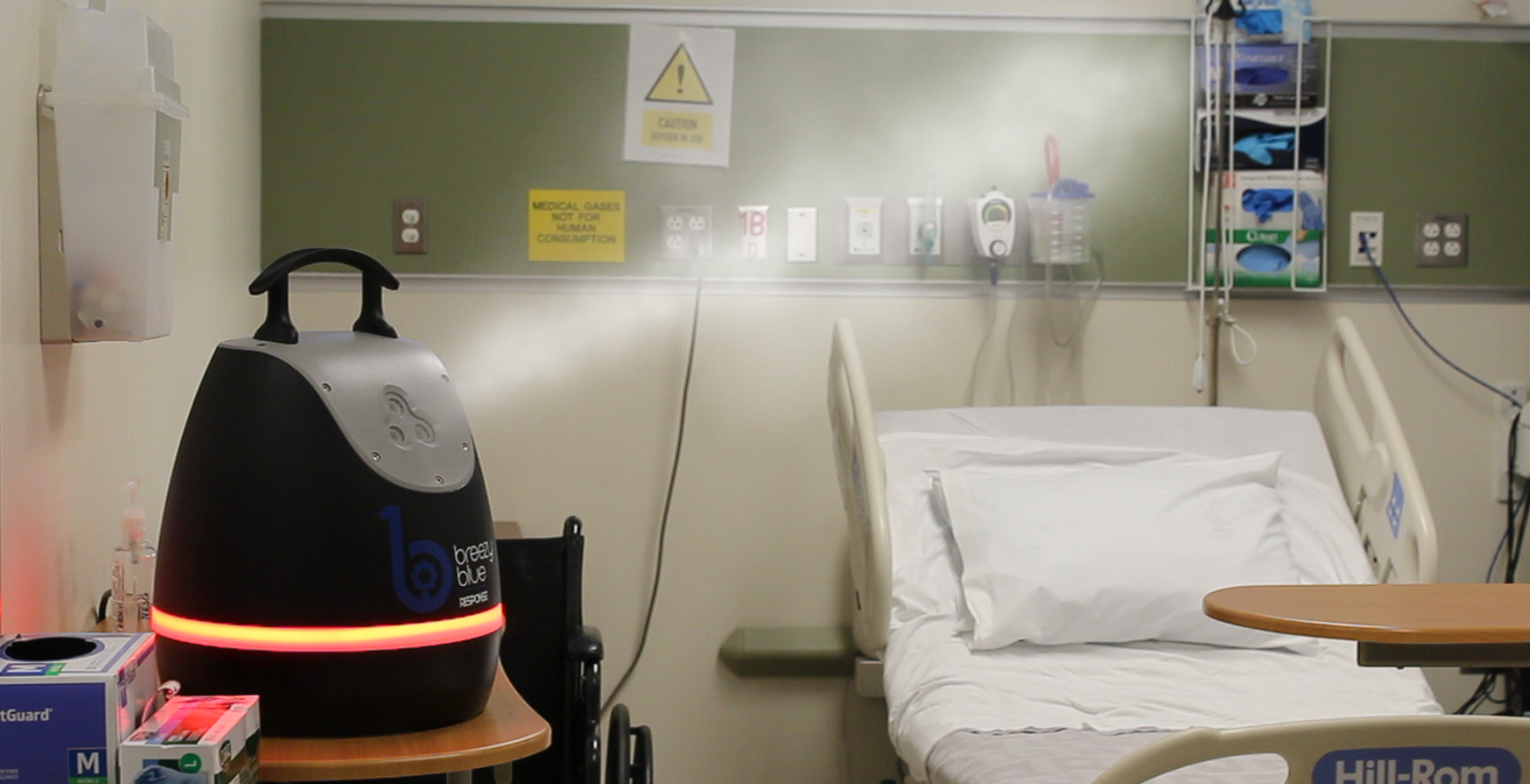
In this new era of heightened health awareness, aerosolized hydrogen peroxide has become an increasingly important tool in battling harmful pathogens. Certain pathogens are notoriously hard to eliminate, and fogging a hydrogen peroxide-based disinfectant enables whole-room coverage across surfaces that are often missed with manual cleaning alone. Let’s dive into how aerosolized hydrogen peroxide works and how automation can make the disinfection process even more efficient.
What is Aerosolized Hydrogen Peroxide?
Aerosolized hydrogen peroxide is a highly effective disinfecting method used to eliminate a wide range of pathogens from surfaces and from the air. This technique involves the generation of a dry mist of hydrogen peroxide particles that settle on surfaces as micron-sized droplets. These aerosolized droplets do not wet surfaces or objects, but instead rapidly evaporate into water and oxygen molecules, leaving no residue. Some of the aerosolized hydrogen peroxide remains in the air as hydrogen peroxide vapor until it breaks down or is diluted with outside air, supporting full-volume exposure throughout the space. The hydrogen peroxide molecules, in aerosol form, have strong oxidizing properties, which enable them to break down membrane lipids, DNA, and other essential cell components of bacteria, viruses, and other microorganisms, rendering them inactive [1].
Aerosolized hydrogen peroxide has a diverse range of applications, such as healthcare facilities, schools, office spaces, and more. This method is particularly valuable in hospitals where thorough and rapid disinfection is crucial, such as patient rooms, operating rooms, and ambulances. Typically, a room will get disinfected with aerosolized hydrogen peroxide after it has been physically cleaned of surface soil, so the dry fog interacts with exposed surfaces and eliminates any remaining pathogens. Moreover, aerosolized hydrogen peroxide is safe for humans when protocols are followed correctly, making it a versatile and efficient choice for combating the spread of infectious agents. Modern aerosolized hydrogen peroxide dry fogging systems are designed to deliver consistent coverage across full room volumes, with validated protocols often supported by biological indicator testing to confirm high-level disinfection performance.
Aerosolized Hydrogen Peroxide use for C. difficile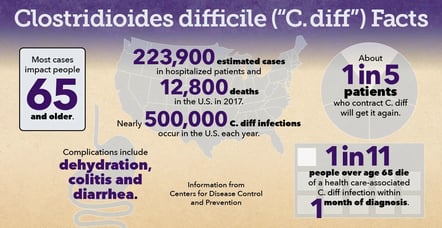
Clostridioides difficile (C. diff) causes a disruption of normal healthy bacteria in the colon. It is the most common cause of healthcare-associated infections (HAI), hospitalizing 223,900 people and killing 12,800 in 2017 in the US alone. C. diff is highly contagious, contaminating surfaces in patient rooms such as handrails, bedside tables, doorknobs, and more. C. diff spores are resistant to many commonly used disinfectants, requiring the use of sporicidal agents. Because spores may remain on surfaces after routine cleaning, supplemental disinfection procedures are recommended.
One disinfection method that is proven to be effective at eliminating C. diff is aerosolized hydrogen peroxide. A study published in the American Journal of Infection Control (AJIC) found that adding aerosolized hydrogen peroxide to standard cleaning procedures significantly reduced C. diff infection rates in hospital settings [2]. Prior to the implementation of aerosolized hydrogen peroxide throughout a 475-bed hospital (July 2009 - September 2011), the facility recorded 120 healthcare-associated C. diff infections. After the implementation of aerosolized hydrogen peroxide (April 2012 - December 2014), only 72 cases were recorded. This is a 41% decrease in C. diff infections, from 4.6 infections per 10,000 patient days to 2.7 per 10,000 patient days. The reduction increased over the next few years, and researchers found a 74% decrease in C. diff infections between January 2015 and December 2019 as a result of implementing aerosolized hydrogen peroxide throughout the hospital.
Benefits of Aerosolized Hydrogen Peroxide Machines
Using aerosolized hydrogen peroxide machines, or H₂O₂ foggers, is a quick and effective way to disinfect rooms such as patient rooms, but they can also be used in office spaces, classrooms, vehicles, and other public spaces where germs tend to spread. When dispersed as a fog, disinfectants can reach all exposed surfaces and distribute throughout the room, including hard-to-reach areas. The small particles can penetrate porous materials such as fabrics and settle on often-missed locations, such as underneath tables and chairs, doorknobs, and small spots between items.
Automated aerosolized hydrogen peroxide systems offer additional operational benefits beyond manual deployment. No workers have to be exposed to the fog; systems can be activated remotely, allowing staff to initiate disinfection and exit the space safely. Additionally, scheduling features allow disinfection to occur automatically at defined times, reducing reliance on manual workflows. Connected systems can automatically log each disinfection event, including timing and location, creating an auditable record that supports compliance, training, and operational visibility. This shift from manual processes to data-driven disinfection helps standardize protocols across staff and reduces variability in execution. Aerosolized hydrogen peroxide is an effective way to eliminate pathogens, and when automated, it reduces labor, minimizes the risk of human error, and supports more consistent and repeatable disinfection workflows [3].
Aerosolized hydrogen peroxide has demonstrated high levels of pathogen reduction in controlled studies, and when paired with automated systems, can support consistent and reliable disinfection practices. Automated aerosolized hydrogen peroxide systems, such as Breezy Blue®, combine automated delivery with connected data platforms, such as Breezy Cloud™, to support more consistent and auditable disinfection practices.
References
[3] Carling PC, et al. "Improving cleaning of the environment surrounding patients in 36 acute care hospitals."
Infection Control & Hospital Epidemiology (2008). DOI: 10.1086/591940