UV Disinfection vs. Electrostatic Sprayers vs. Disinfectant Fogging: What's the Difference?
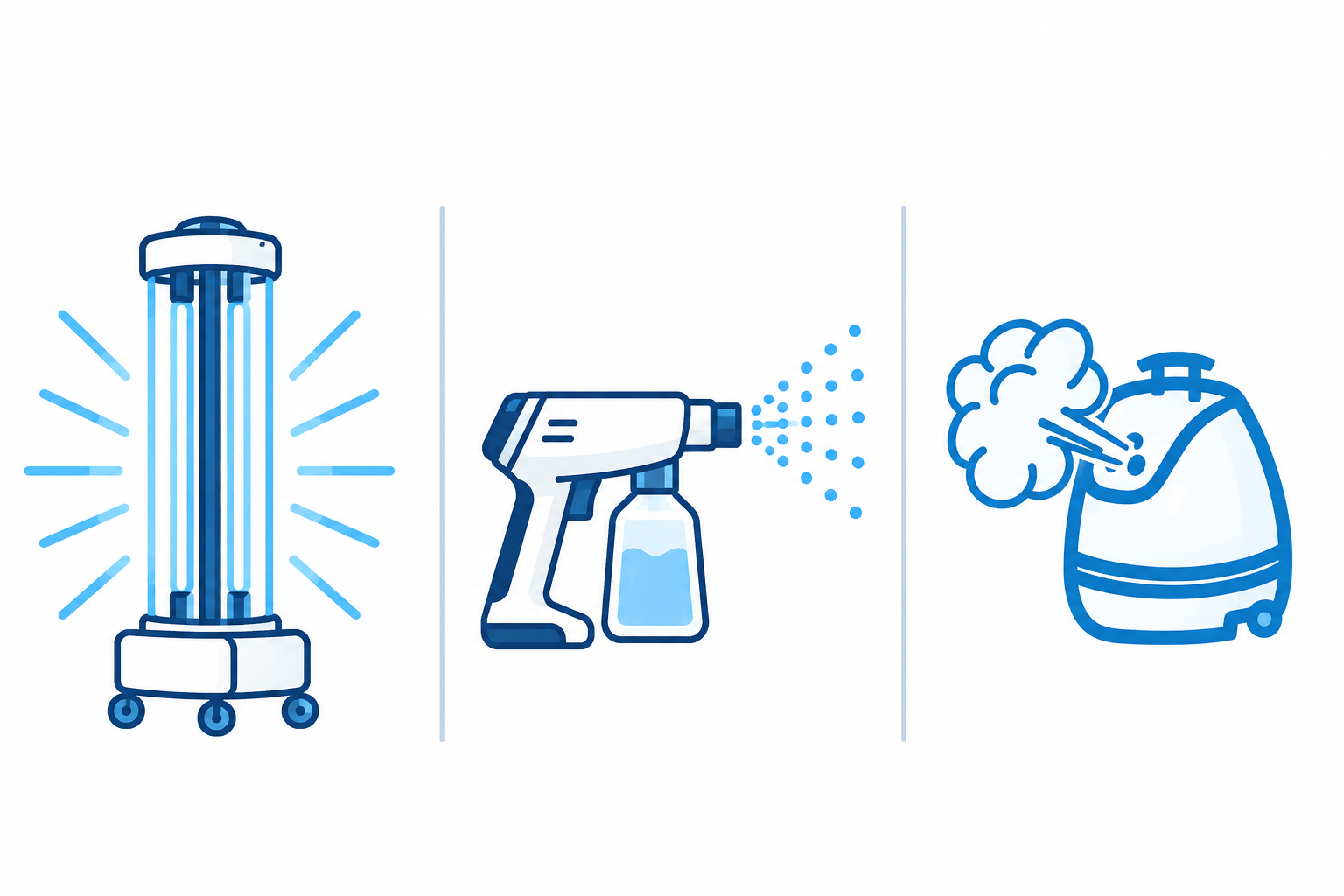
Hospitals and other facilities use several technologies to supplement manual cleaning and disinfection. Among the most common are ultraviolet (UV) disinfection systems, electrostatic sprayers, and disinfectant fogging systems.
Although all three approaches can support environmental disinfection, they work differently. Their effectiveness, room coverage, staff requirements, and operating costs depend on the equipment, disinfectant, treatment protocol, and application.
Understanding these differences can help facilities choose an approach that fits their needs.
UV Disinfection
UV disinfection systems use germicidal ultraviolet energy to inactivate microorganisms on exposed surfaces. In hospitals, these systems are commonly used as an additional disinfection step after manual cleaning.
One advantage of UV is that it does not require chemical disinfectant consumables. However, the amount of UV energy reaching a surface depends on factors such as distance, room geometry, equipment, furnishings, and obstructions.
Some UV systems use multiple device positions or emitters to address these challenges. Treatment times and staff requirements vary by system and protocol.
When evaluating UV disinfection, facilities should consider the complete workflow, including equipment transport, setup, required placements, treatment cycles, and documentation.
For a more detailed evaluation, see our Guide to Hospital UV Disinfection Systems, including important differences among leading UV technologies.
Electrostatic Sprayers
Electrostatic sprayers apply liquid disinfectants using electrically charged droplets designed to improve deposition on surfaces.
Unlike automated room disinfection systems, electrostatic spraying generally requires an operator to move through the treatment area and apply disinfectant to the intended surfaces.
This can be useful for treating equipment, furnishings, and other accessible surfaces. However, effectiveness depends on the disinfectant's labeled application method, sufficient surface coverage, required contact time, and proper operator technique.
Facilities should also consider personal protective equipment, ventilation requirements, staff time, and any restrictions on room occupancy or reentry.
Electrostatic spraying is primarily a method of applying a disinfectant. It should not be assumed to provide the same treatment distribution or workflow as an automated whole-room system.
Disinfectant Fogging and Aerosolized Hydrogen Peroxide
Disinfectant fogging disperses liquid disinfectant into an enclosed treatment space as small droplets or an aerosol.
Unlike electrostatic spraying, certain fogging systems can operate automatically after the room has been prepared and the operator has exited.
Aerosolized hydrogen peroxide is one approach used for automated room disinfection. Rather than depending on ultraviolet energy reaching each target surface, it disperses disinfectant throughout the treatment space.
This can provide a different approach to treating complex room environments, including areas that may be difficult to expose directly to UV light.
However, not all fogging systems are equivalent. Disinfectant chemistry, droplet characteristics, treatment protocols, room conditions, and supporting efficacy evidence all matter.
Facilities should evaluate the complete process, including preparation, treatment time, required contact time, ventilation or clearance requirements, and safe reentry.
How Do the Three Methods Compare?
| Consideration | UV Disinfection | Electrostatic Spraying | Automated Aerosolized Hydrogen Peroxide |
|---|---|---|---|
| Treatment method | Germicidal UV energy | Applied liquid disinfectant | Dispersed disinfectant aerosol |
| Surface access | Depends on delivered UV energy and room geometry | Depends on operator application | Depends on aerosol distribution and validated protocol |
| Operator involvement | Setup and potentially multiple placements | Active application | Setup and automated treatment |
| Chemical consumables | No | Yes | Yes |
| Room occupancy | Generally unoccupied during whole-room UV treatment | Depends on product and protocol | Unoccupied during treatment |
| Key considerations | UV dose, coverage, placements, workflow | Application technique, contact time, PPE | Distribution, exposure, workflow |
These are general distinctions, not performance rankings. Actual requirements vary by system and application.
Choosing the Right Disinfection Approach
The most appropriate technology depends on where and how it will be used.
For hospitals, the decision should extend beyond the advertised treatment time or equipment price. Important considerations include:
-
Room coverage: Can the required treatment reach the intended surfaces?
-
Workflow: How much total room time and active staff time does the process require?
-
Availability: Can the equipment be deployed where and when it is needed?
-
Evidence: What testing or clinical research supports the intended application?
-
Documentation: Can the facility verify and review completed treatments?
-
Economics: What are the total costs of equipment, labor, consumables, service, and maintenance?
These technologies can serve different purposes within the same facility. None eliminates the need for appropriate manual cleaning.
Where Breezy Blue Fits
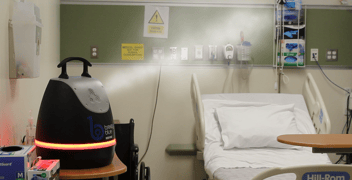
Breezy Blue® is an automated room disinfection system that uses aerosolized hydrogen peroxide as a supplemental step after manual cleaning.
The system is designed for a straightforward workflow: position the equipment, select the treatment, initiate the automated process, and leave the room while treatment is completed.
Breezy Cloud™ provides connected documentation of disinfection activity, helping facilities review treatment history, equipment utilization, and protocol adherence.
For hospitals currently using or evaluating UV, Breezy Blue may provide an additional option for rooms or applications where UV equipment availability, treatment coverage, or workflow presents challenges.
Evaluating UV disinfection for your hospital?
Explore our Hospital UV Disinfection Systems and Alternatives guide to compare technologies, room workflows, clinical evidence, and operating economics.