
Evaluating UV Disinfection Systems for Your Hospital?
UV disinfection systems can provide an automated, supplemental step after manual cleaning and disinfection. But not all UV systems work the same way—and UV is not the only approach to automated room disinfection.
Before selecting a system, understand the differences in technology, room coverage, workflow, evidence and total cost.
Not All Hospital UV Systems Are the Same
Hospital UV disinfection systems use germicidal ultraviolet energy to reduce microorganisms on exposed surfaces, but the way that energy is generated and delivered varies by system.
| Continuous UV-C | Pulsed Xenon UV (PX-UV) | |
| Light delivery | Continuous | High-intensity pulses |
| Spectrum | Commonly centered near 254 nm | Broader spectrum including germicidal UV |
| Representative systems | Tru-D, UVDI, Surfacide | Xenex |
Why this matters: UV disinfection is not a single standardized technology. The specific system design, treatment protocol and room workflow determine how each approach performs in practice.
Room Coverage
How does the system deliver treatment throughout the room? Consider distance, room geometry, equipment and furnishings, bathrooms, and surfaces that may be obstructed or difficult to reach.
Complete Workflow
Look beyond the advertised treatment cycle. Consider the total time and staff effort required to transport the equipment, set it up, complete required placements or cycles, and release the room for use.
Storage & Transport
Where will the equipment be stored? How easily can staff move it between patient rooms, departments and floors? Storage space and equipment availability can affect how consistently a system is used.
Training & Proper Use
What does staff need to know to perform a treatment correctly? Consider initial training, new-employee training and how easily staff can consistently follow the required protocol during normal hospital operations.
Maintenance & Reliability
What routine maintenance and service does the system require? Consider lamp replacement, disposal of mercury-containing lamps, calibration or other preventive maintenance, service requirements and the operational impact when equipment is unavailable.
Verification & Documentation
How does the hospital know treatments were completed as intended? Consider what the system records, how treatment data are accessed, and whether Infection Prevention, EVS and hospital leadership can easily review utilization and treatment history to identify gaps, trigger corrective action or support retraining.
Clinical Evidence
What clinical evidence supports the technology and the applications you intend to address? Consider the type of evidence, what the evidence actually measured, and whether the findings apply to the specific system, protocol and use case being evaluated.
Total Cost
Look beyond the equipment capital cost. Include service and maintenance, consumables, staff time, treatment throughput, equipment utilization and future replacement requirements. Consider whether subscription or other financing options are available to reduce upfront expense and long-term capital commitments.
The practical question is whether your hospital can execute the required process consistently, treatment after treatment, with a workflow and total cost that are sustainable.
Hospital UV Systems You May Be Evaluating
Several UV systems are used in hospital environmental disinfection. They differ in UV technology, equipment configuration, treatment protocols and workflow.
Xenex LightStrike+
LightStrike+ uses high-intensity, broad-spectrum pulsed xenon UV. Treatment protocols can be customized by room type and position, and the system provides cloud-based reporting of treatment activity.
Tru-D SmartUVC
Tru-D uses 254 nm UV-C with dose-sensing technology. Its current portfolio includes single-tower and multi-device configurations designed to support automated room treatment and reporting.
UVDI-360
The UVDI-360 is a mobile UV-C room disinfection system. It supports on-device or remote operation, records treatment information and offers connected device monitoring and cloud-based data transfer.
Surfacide Helios+
Helios+ uses up to three UV-C emitters operating during the same treatment cycle. Its multi-emitter configuration is designed to deliver UV-C energy from multiple positions without repositioning the emitters during the cycle.
The differences between systems extend beyond the UV source. Compare the complete treatment protocol and operating requirements for the rooms and applications your hospital intends to address.
How Many Placements Does a Room Treatment Require?
A stated treatment time may represent only one device position or one cycle. To understand the actual impact on room turnover and staff time, determine how many placements or cycles are required to treat the room, including bathrooms or other spaces that may require a separate treatment. 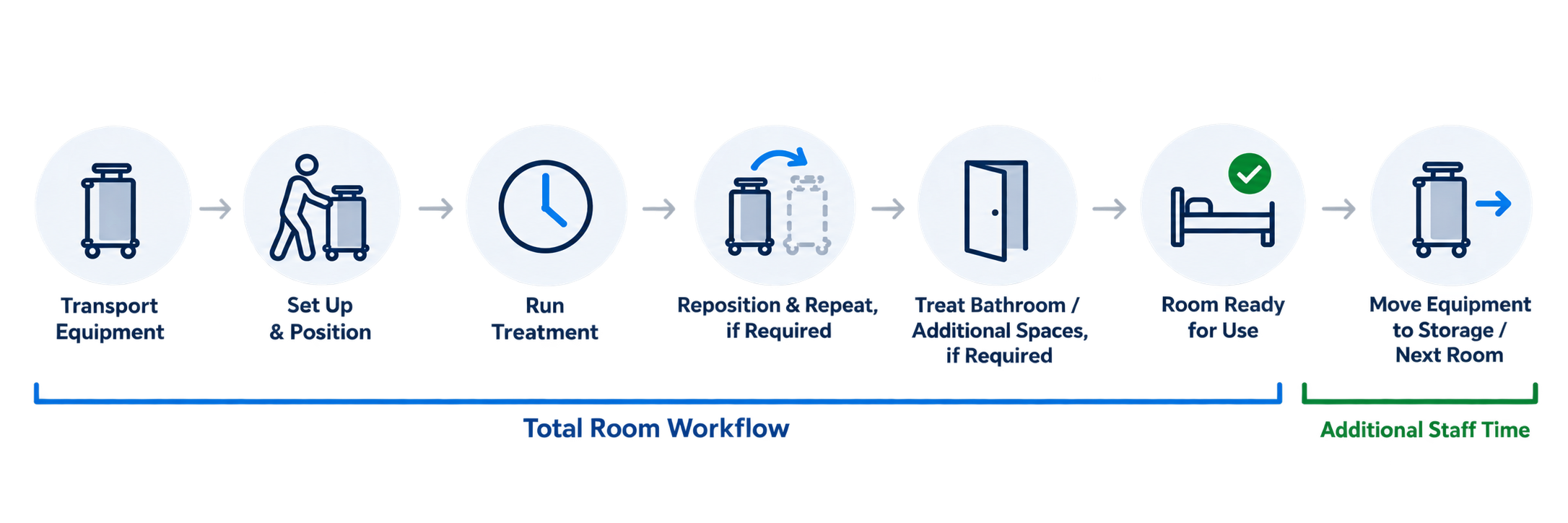
Translate Workflow into Economics
A useful comparison considers both the cost of the system and the resources required to operate it:
Annual treatment volume × active staff time × loaded labor rate = annual treatment labor cost
Add equipment, service, maintenance, consumables and replacement requirements to understand the broader cost of operating the program.
The right comparison uses your hospital's applications, treatment volumes, staffing and workflow—not a generic cost-per-cycle estimate.
UV Is One Approach to Automated Room Disinfection
If your hospital is evaluating UV, it may also be useful to consider other approaches to automated room disinfection.
UV disinfection delivers germicidal energy to surfaces reached by the light. Aerosolized hydrogen peroxide takes a different approach, dispersing a disinfectant throughout the treatment space.
That fundamental difference affects what hospitals should evaluate.
| UV Systems | Aerosolized Hydrogen Peroxide Systems |
| Uses germicidal ultraviolet energy | Disperses a liquid disinfectant as an aerosol |
| Treatment depends on UV energy reaching the target surface | Aerosol is dispersed throughout the treatment space |
| Distance, room geometry and obstructions can affect delivered UV energy | Application depends on delivering the validated disinfectant exposure across the treatment area |
Neither category should be evaluated on technology alone. Compare the specific system, protocol, evidence, workflow and economics for the applications your hospital intends to address.
Meet Breezy Blue®: A Modern Approach to Automated Room Disinfection
Breezy Blue® uses aerosolized hydrogen peroxide to provide automated, supplemental room disinfection after manual cleaning. Instead of relying on UV energy reaching each target surface, Breezy disperses disinfectant throughout the treatment space.
The system is designed around a simple workflow: position Breezy Blue, select the treatment, start the automated process, leave the room and allow the treatment to complete—without repositioning the system.
More Than Room Disinfection
Breezy Cloud™ automatically creates a digital record of disinfection activity, including where and when rooms were disinfected, system utilization and optional dosage data. Infection Prevention and EVS can review this information to monitor protocol adherence, identify gaps and support corrective action or retraining.
Together, Breezy Blue and Breezy Cloud provide a connected approach to automated room disinfection—combining the physical disinfection process with the data hospitals need to monitor utilization, review disinfection activity and improve protocol adherence.
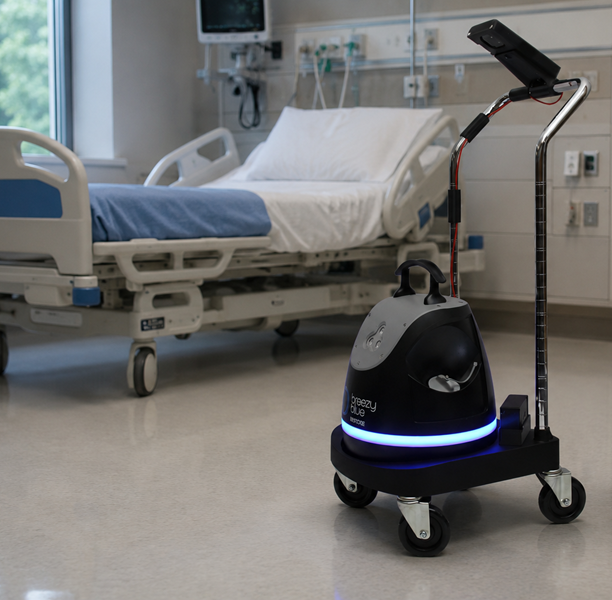
Breezy Blue®: Automated room disinfection using aerosolized hydrogen peroxide
See How Breezy Compares with UV at Your Hospital
The most useful comparison is based on your hospital's actual applications and workflow—not generic cycle times or cost-per-treatment estimates.
-
Rooms and applications you intend to address
-
Number of placements or cycles required
-
Total room time and active staff time
-
Treatment volume and equipment utilization
-
Capital or subscription costs
-
Service, maintenance and consumables
-
Documentation and verification requirements
Frequently Asked Questions About Hospital UV Disinfection
Selected Evidence & References
Independent Literature
Demeersseman N, et al.
Shedding a light on ultraviolet-C technologies in the hospital environment. Journal of Hospital Infection. 2023;132:85–92.
Review of UV-C technologies and factors affecting disinfection performance, including wavelength, dose, distance and shadowing.
Dukes JL, et al.
Facilitators and barriers for the use of ultraviolet-C disinfection for patient room cleaning at VA hospitals: a qualitative analysis. Infection Control & Hospital Epidemiology. 2025.
Qualitative study of personnel across 22 VA hospitals examining real-world UV-C implementation, including workflow, training, staffing, storage and equipment considerations.
Breezy-Specific Literature
Lazarus HM, et al.
Automated Hospital Room Disinfection Utilizing a Novel Aerosolized Hydrogen Peroxide Microdroplet Disbursing Technology. Journal of Visualized Experiments. 2026.
Peer-reviewed evaluation of the Breezy automated aerosolized hydrogen peroxide system and treatment protocol.
Navas CD, et al.
Advancing the science of hydrogen peroxide disinfection. American Journal of Infection Control. 2026.
Discussion of advances in aerosolized hydrogen peroxide disinfection and considerations for evaluating emerging room-disinfection technologies.