
JoVE Publishes Clinical Protocol for Automated Hospital Room Disinfection Using Breezy
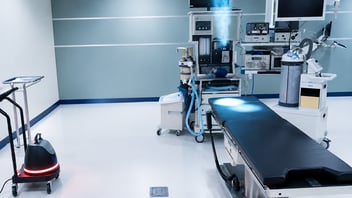
Breezy Med is pleased to share the publication of a new peer-reviewed article in the Journal of Visualized Experiments (JoVE) detailing automated hospital room disinfection using a novel aerosolized hydrogen peroxide protocol.
This publication represents an important clinical milestone. The study, developed through multi-disciplinary collaboration among hospital infection prevention leaders and clinical colleagues, evaluates automated aerosolized hydrogen peroxide as part of terminal cleaning in environments affected by carbapenem-resistant organisms (CROs) and other multidrug-resistant organisms (MDROs).
For healthcare leaders, this is more than a laboratory validation. It is real-world clinical evidence demonstrating that automation, when properly implemented, can reduce pathogen transmission.
Study Focus: Terminal Cleaning in CRO/MDRO Environments
The published protocol evaluated automated aerosolized hydrogen peroxide disinfection during terminal cleaning of patient rooms in high-risk settings with CRO/MDRO exposure. Manual cleaning alone served as the comparison condition.
The primary clinical finding: implementation of automated aerosolized hydrogen peroxide terminal disinfection was associated with reduced transmission of carbapenem-resistant organisms.
While laboratory biological indicator (BI) testing demonstrated consistent 4-log to 5-log reductions using Bacillus atrophaeus spores, the central contribution of the publication is its clinical outcome data — showing measurable impact on organism transmission within the hospital environment.
This distinction is important. Many disinfection technologies demonstrate laboratory efficacy. Fewer show downstream effects on transmission dynamics within complex healthcare workflows.
Validating a Novel Algorithm and Protocol Approach
The study utilized the novel aerosolized hydrogen peroxide dry fogging algorithm of Breezy Blue® that optimizes dry fog distribution and whole-room coverage. The publication details how automated aerosolization, controlled humidity ramping, and structured cycle timing support consistent environmental exposure.
This protocol-driven approach reduces the variability inherent in manual processes. The system removes common human errors that can compromise terminal disinfection quality by automating the following:
-
Fog generation
-
Dwell time
-
Cycle completion
-
Electronic documentation
The JoVE video format further strengthens the contribution by visually demonstrating:
-
Room preparation
-
Equipment setup and use
-
Fog dispersion details
-
Post-cycle re-entry and verification
For infection prevention teams, this provides procedural clarity that is often missing from written reports alone.
Beyond Log Reduction: Operational Oversight
In addition to CRO transmission reduction, the publication highlights the operational advantages of automation.
The integration of audit-ready digital reports provided enhanced oversight of terminal disinfection events. Automated documentation ensured that cycles were completed according to protocol and created a defensible record for quality review, accreditation preparation, and outbreak response analysis.
This dual impact — clinical transmission reduction combined with documentation integrity — is particularly relevant for:
-
Infection preventionists managing MDRO containment
-
EVS leaders responsible for consistency
-
Hospital executives focused on risk mitigation
Automation does not replace manual cleaning. Rather, it standardizes and reinforces the final disinfection step in high-risk environments.
Why This Publication Matters
Peer-reviewed publication in JoVE represents a significant credibility milestone for automated aerosolized hydrogen peroxide in healthcare environments.
First, it documents a reproducible protocol.
Second, it demonstrates measurable clinical outcomes.
Third, it reinforces that algorithm-driven aerosolization can translate laboratory efficacy into real-world transmission impact.
For hospitals confronting rising CRO prevalence, emerging pathogens, and increased regulatory scrutiny, terminal cleaning performance is under greater evaluation than ever before. Evidence supporting structured, automated approaches strengthens the case for evolving beyond manual-only disinfection models.
This study adds to the growing body of literature supporting aerosolized hydrogen peroxide as an effective adjunct to manual cleaning in healthcare settings.
A Collaborative Effort
The publication reflects a multi-disciplinary collaboration among clinical practitioners, infection prevention leaders, and operational teams committed to improving environmental hygiene outcomes.
Importantly, the work was conducted within active healthcare environments, demonstrating that structured automated protocols can be integrated into real hospital workflows.
Read the Full Article
We encourage healthcare leaders, infection preventionists, and EVS professionals to review the full JoVE publication:
“Automated Hospital Room Disinfection Utilizing Novel Aerosolized Hydrogen Peroxide Protocols”
Available through the Journal of Visualized Experiments (JoVE) website.
The video-based format provides detailed procedural insight and supports reproducibility for organizations evaluating automated aerosolized hydrogen peroxide as part of their MDRO containment strategy.