
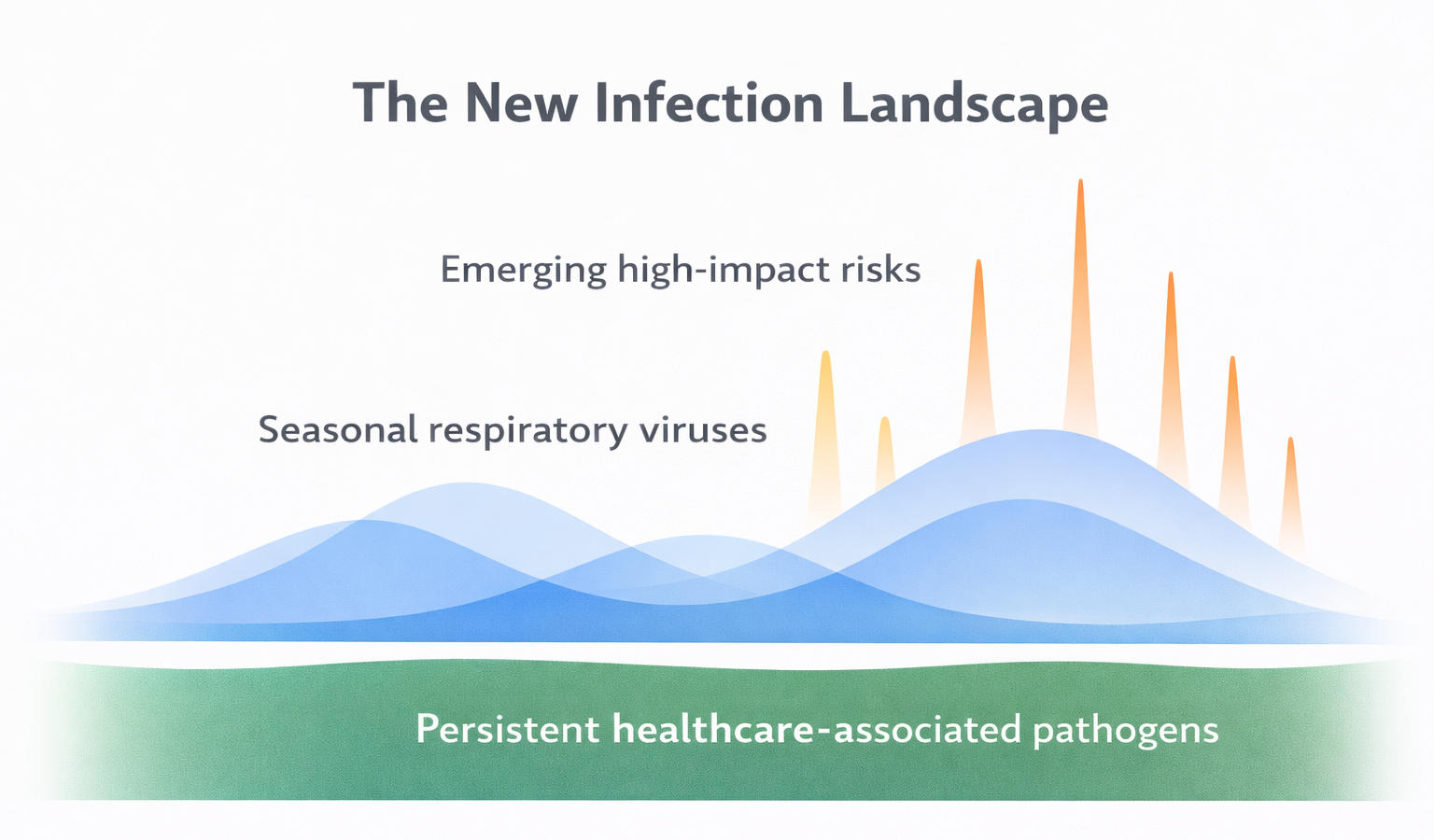
The 2025–26 respiratory season reflects a continued transition in infectious disease dynamics within healthcare environments. Peer-reviewed literature no longer supports viewing “flu season” as a singular, predictable event. Instead, hospitals are managing a multi-pathogen landscape shaped by evolving viral behavior, persistent healthcare-associated organisms, and emerging high-consequence threats. This season reinforces a critical shift: respiratory infection risk is no longer seasonal—it is continuous and overlapping.
A Multi-Pathogen Respiratory Season
Peer-reviewed studies from the past two years show that respiratory illness patterns have not fully returned to pre-pandemic norms. Instead, the 2025–26 season reflects a broader mix of circulating pathogens, including influenza, SARS-CoV-2, RSV, rhinovirus, adenovirus, and human metapneumovirus (hMPV) [1][2].
Recent analyses demonstrate:
-
Rhinovirus and adenovirus continue to circulate year-round
-
RSV and influenza have re-established seasonality, though with variable timing
-
Co-circulation of multiple viruses is now common rather than episodic
A 2025 multinational study found a consistent post-pandemic sequence of viral resurgence, with rhinovirus returning first, followed by seasonal coronaviruses, RSV, and influenza. For healthcare systems, this results in overlapping respiratory burdens rather than a single peak period.
COVID-19: Continued Evolution Without Dominance
COVID-19 is now endemic, with ongoing evolution and continued clinical relevance. While it no longer dominates hospital operations, it remains a persistent component of respiratory disease burden. Recent studies in The Lancet Infectious Diseases and Cell Reports describe emerging variants, including BA.3.2 and NB.1.8.1, with:
-
Increased immune evasion capabilities
-
Alterations in spike protein binding
At the same time, comparative studies (e.g. JAMA) suggest that short-term hospitalization risk for COVID-19 is now more comparable to influenza, though longer-term outcomes may still differ [7].
The implication is clear: COVID-19 has transitioned from a dominant crisis to a persistent, evolving component of respiratory disease burden.
Influenza and RSV: Persistent Variability
Influenza and RSV continued to demonstrate seasonal resurgence with variability, rather than predictable annual patterns.
Peer-reviewed findings from recent seasons show:
-
Shifting timing and duration of influenza peaks
-
Regional variability in dominant strains (e.g. emerging H3N2 subclades, including subclade K) [7]
-
Continued RSV burden, particularly among pediatric and older adult populations
This variability complicates staffing, capacity planning, and infection prevention workflows, reinforcing the need for flexible and scalable response strategies.
Expanding Respiratory Risk: Measles and H5N1
Measles: rare, but operationally disruptive
Peer-reviewed literature highlights a global resurgence of measles driven by declining vaccination coverage and post-pandemic immunity gaps [8]. With a basic reproduction number (R₀) of 12–18, measles is among the most transmissible human pathogens.
Although incidence remains low in the U.S., even a single case can trigger extensive exposure investigations, staff furloughs, and significant operational disruption within healthcare settings.
H5N1 avian influenza: preparedness over prevalence
H5N1 continues to be monitored due to its pandemic potential, despite limited human-to-human transmission. Recent spillover events into mammals have increased scientific attention [9].
For healthcare systems, the primary implication is preparedness, not current burden.
Emerging Risks: Resistant Pathogens and Environmental Persistence
Alongside a broad range of respiratory viruses requiring constant vigilance, resistant pathogens continue to emerge and evolve, challenging infection prevention and treatment strategies.
Candida auris: environmental persistence and outbreak risk
C. auris continues to emerge as a significant multidrug-resistant organism in healthcare settings. Peer-reviewed studies emphasize its ability to persist on surfaces and equipment, contributing to prolonged outbreaks and transmission [10].
Transmission remains primarily healthcare-associated, reinforcing the importance of environmental disinfection and monitoring.
Clostridioides difficile infection: sustained burden
C. difficile infections remain one of the most common healthcare-associated infections. Its spore-forming nature enables long-term environmental survival and resistance to many disinfectants [11].
Recent literature highlights stable overall incidence but growing attention to community-associated infections and antimicrobial resistance trends.
What This Season Makes Clear
Across peer-reviewed research and observed healthcare trends, a consistent conclusion emerges. Healthcare systems are now managing:
-
Concurrent respiratory viruses with overlapping peaks
-
A growing number of persistent, resistent healthcare-associated pathogens with environmental transmission
-
Threats of high-impact outbreaks driven by a growing set of organisms of concern
Implications for Infection Prevention
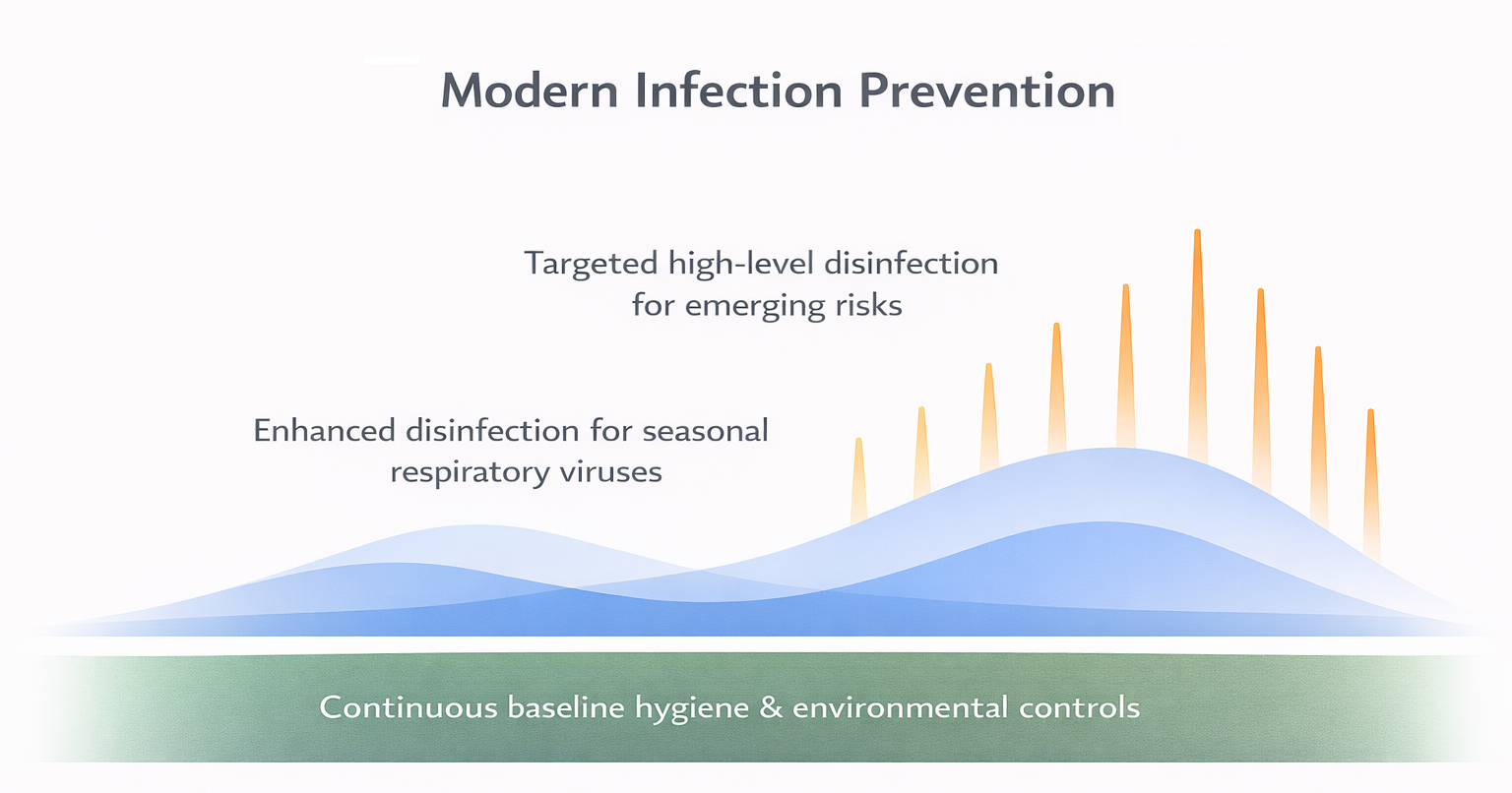
Today's continuous, multi-pathogen respiratory risk places new demands on infection prevention programs:
- Increased need for whole-environment coverage, not just targeted cleaning
-
Stronger reliance on data, validation, and repeatable workflows
As the pathogen landscape becomes more complex, the most effective strategies are those that can be applied reliably across use cases—regardless of pathogen type or timing.
Conclusion
The 2025–26 season marked a clear shift rather than a return to prior patterns. Infection risk in healthcare settings continues to be more challenging, less seasonal in nature, and driven by multiple overlapping factors.
For hospital leaders, infection prevention is no longer about preparing for the next surge. It is about building systems that perform every day, across every pathogen scenario.
Greater emphasis must now placed on approaches that provide consistent, routine, whole-environment coverage—supported by validated protocols and data—to reduce variability and improve reliability across use cases.
Breezy Med’s aerosolized hydrogen peroxide systems are designed to support this model, enabling repeatable, whole-room disinfection with audit-ready documentation.
Healthcare organizations interested in contributing to the evidence base are encouraged to participate in the Breezy Med Clinical Evidence and Research Network.
References
.jpg?width=352&name=Cold%20Flu%20and%20Breezy%20Blue%20(image).jpg)