Infection prevention teams invest significant effort developing environmental cleaning and disinfection protocols intended to reduce disease transmission and healthcare-associated infections (HAIs). These initiatives often involve new technologies, updated workflows, staff training, and cross-functional coordination between infection prevention, environmental services (EVS), quality, and nursing teams.
Yet once a new initiative moves into daily practice, visibility often drops sharply.
Many infection prevention leaders tell us they face a common challenge: they can define policies and procedures, but they often have limited visibility into whether those procedures are consistently executed as intended across rooms, shifts, and operators. This creates a difficult question—can you trust the outcome if you cannot verify the implementation?
Without meaningful verification, protocol adherence is often inferred rather than measured. This makes it difficult to identify process gaps, understand unexpected outcomes, and continuously improve performance.
Why Dosage Matters in Whole-Room Disinfection
Automated whole-room disinfection systems improve consistency by reducing the variability associated with manual cleaning alone [1]. However, cycle completion does not necessarily guarantee effective disinfection.
In aerosolized hydrogen peroxide disinfection, efficacy depends on more than simply dispensing disinfectant into a room. Effective microbial reduction depends on delivering sufficient disinfectant dose to surfaces throughout the treated space.
-
Selected treatment settings, including room size and target dose
-
Disinfectant concentration and distributed liquid volume
-
Environmental conditions such as relative humidity
-
Airflow dynamics and ventilation
-
Room geometry, surface accessibility, and obstructions
These variables can significantly influence how aerosolized disinfectant disperses, deposits, and interacts with surfaces [2].
In real healthcare environments, no two rooms are exactly alike. Differences in ventilation, clutter, furniture arrangement, room size, and workflow can create meaningful variation in treatment conditions. Even when using automated systems, these variables can affect coverage and disinfection performance.
The Verification Gap
Most healthcare facilities rely on a combination of workflow documentation, checklists, cycle logs, and periodic validation methods such as ATP testing, biological indicators (BIs), or environmental sampling.
Each of these tools provides value—but each also has limitations.
Checklists and workflow logs help confirm that a procedure was performed, but they do not verify that effective disinfection conditions were achieved. ATP testing is commonly used to assess surface cleanliness by measuring residual organic material, making it useful for evaluating cleaning performance. However, ATP does not directly measure viable pathogens or confirm microbial kill following a disinfection process [3].
Biological indicators remain the gold standard for validating disinfection efficacy because they directly assess microbial inactivation. However, they are typically labor-intensive, require incubation time, and are used periodically rather than routinely. Surface sampling methods can provide additional insight but often require manual collection, laboratory processing, and delayed analysis.
As a result, many healthcare teams face a verification gap between documented procedure completion and confidence that effective disinfection conditions were achieved.
Many whole-room disinfection systems can document cycle completion. Few provide practical tools to verify environmental dosage at the room level.
Introducing Breezy Trace™
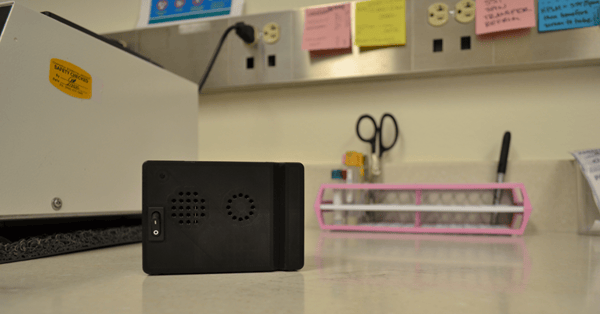
Breezy Trace™ was developed to help close this verification gap.
-
Measured hydrogen peroxide concentration over time
-
Relative humidity
-
Temperature
These measurements help quantify the environmental conditions achieved during a disinfection cycle and provide additional confidence that treatment parameters align with validated disinfection protocols.
Rather than relying solely on assumptions or indirect indicators, healthcare teams can use Breezy Trace™ to better understand actual room-level disinfection conditions.
High-Value Use Cases for Breezy Trace™
Coverage Mapping During Implementation
During initial implementation of an aerosolized hydrogen peroxide disinfection system, healthcare teams can validate protocol performance across room types, establish baseline conditions, and identify opportunities for optimization.
One or more Breezy Trace™ devices may be positioned at different locations within a room to characterize how room geometry, airflow, and obstructions influence treatment conditions. This helps teams identify coverage gaps, validate deployment protocols, and optimize treatment performance. Using this data, teams can customize Breezy Controller™ settings for specific rooms or room types in real time to help ensure the intended disinfectant dose is delivered.
Periodic Quality Assurance Verification
Treatment conditions can change over time as workflows, room layouts, and facility operations evolve.
Periodic verification using Breezy Trace™ helps ensure disinfection protocols continue performing as expected and supports ongoing quality assurance programs. In addition to scheduled spot checks, Trace can help identify operator variability or retraining needs, detect changes in environmental conditions, and monitor for unexpected chemical or equipment degradation.
This enables healthcare teams to identify potential issues early, investigate root causes, and maintain confidence in long-term protocol performance.
Troubleshooting and Compliance Support
Trace also provides valuable insight when investigating unusual rooms or workflow exceptions.
Rooms with complex layouts, high air exchange rates, or operational constraints may benefit from additional verification. Trace data can help teams troubleshoot these environments and support internal quality reviews, accreditation preparation, and protocol refinement.
From Disinfection Events to Operational Intelligence
The future of hospital disinfection is not just automation—it is measurable, connected, and data-driven.
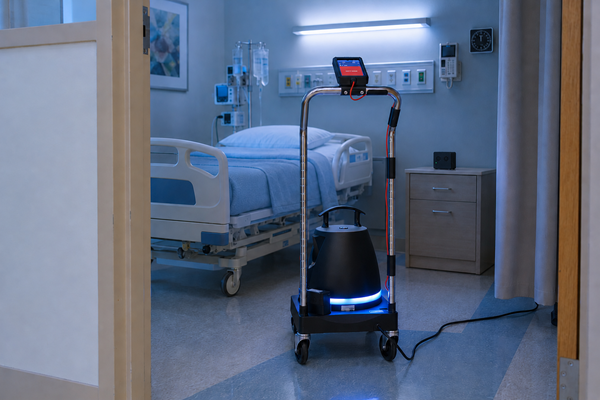
Breezy Trace™ is part of the broader Breezy Med smart disinfection ecosystem, integrating with Breezy Blue® and Breezy Cloud™ to provide more than simple cycle execution.
Together, these technologies help healthcare teams move from isolated disinfection events toward operational intelligence. Instead of simply recording that a cycle occurred, hospitals can better understand how disinfection protocols perform across rooms, workflows, and time. This enables continuous learning, stronger compliance, improved patient safety, and more efficient hospital operations.
This also creates an opportunity to transform infection prevention initiatives from policy-driven programs into measurable operational solutions. Instead of simply implementing new procedures and hoping for consistent adoption, hospitals can gain visibility into real-world execution, identify performance gaps, and continuously improve workflows.
Greater operational visibility helps translate infection prevention efforts into practical business value by reducing preventable costs, improving labor efficiency, and supporting more predictable room turnover and resource utilization [4].
Looking Ahead
Effective infection prevention requires more than well-designed procedures. It requires confidence that those procedures are consistently executed and achieving intended results.
Automation improves consistency. Logging provides visibility. Verification builds confidence.
By combining automation, visibility, and verification, healthcare teams can move beyond procedure compliance to better understand protocol performance, improve workflows, and strengthen confidence in infection prevention outcomes.
To learn more about Breezy Trace™ or schedule a demonstration, visit the Breezy Trace™ product page or contact the Breezy Med team.
Refences
[1] Otter JA, Yezli S, Perl TM, et al. The role of ‘no-touch’ automated room disinfection systems in infection prevention and control. Journal of Hospital Infection. 2013;83(1):1–13. doi:10.1016/j.jhin.2012.10.002.
[2] Fu TY, Gent P, Kumar V. Efficacy, efficiency and safety aspects of hydrogen peroxide vapour and aerosolized hydrogen peroxide room disinfection systems. Journal of Hospital Infection. 2012;80(3):199–205. doi:10.1016/j.jhin.2011.11.019.
[3] Mulvey D, Redding P, Robertson C, et al. Finding a benchmark for monitoring hospital cleanliness. Journal of Hospital Infection. 2011;77(1):25–30. doi:10.1016/j.jhin.2010.08.006.
[4] Truitt CL, Koganti S, Gill J, et al. Evaluation of an aerosolized hydrogen peroxide disinfection system for the reduction of Clostridioides difficile hospital infection rates over a 10-year period. American Journal of Infection Control. 2022;50(7):741–746. doi:10.1016/j.ajic.2022.02.010.